Infrared Heating & Electrification: A Clear Signal from the 6th IG Infrarot Round Table
Two Days at IG Infrarot in Wuerzburg – A Clear Signal for the Future of Building Heat
The 6th Round Table of the infrared heating industry and the subsequent conference "Infrared Heating: Key to Affordable Building and Living" by IG Infrarot in Wuerzburg clearly demonstrated: The industry has matured. Discussions were solution-oriented, practical examples were convincing – and the regulatory framework is moving in the right direction.
Infrared heating has found its place in the energy system – and a central one at that.
Electrification as the Common Denominator
When you bring together the presentations, studies, and practical examples from the conference, a clear picture emerges: Buildings, mobility, and industry are going electric. Electrification is the central lever on the path to climate neutrality by 2045. The question is no longer "whether," but "how intelligently."
As Lars Keussen, first chairman of IG Infrarot Deutschland e.V., aptly summarized: The industry has become more confident and solution-oriented. More and more real estate projects – large and small – are gaining momentum. A dynamic is emerging that inspires confidence.
Particularly encouraging: The reduction of the primary energy factor for electricity from fp=1.8 to fp=1.3 – driven by the growing share of renewable energy in the power mix – significantly improves the regulatory assessment of electric heating systems. Those who calculate with the new figures immediately recognize the potential.
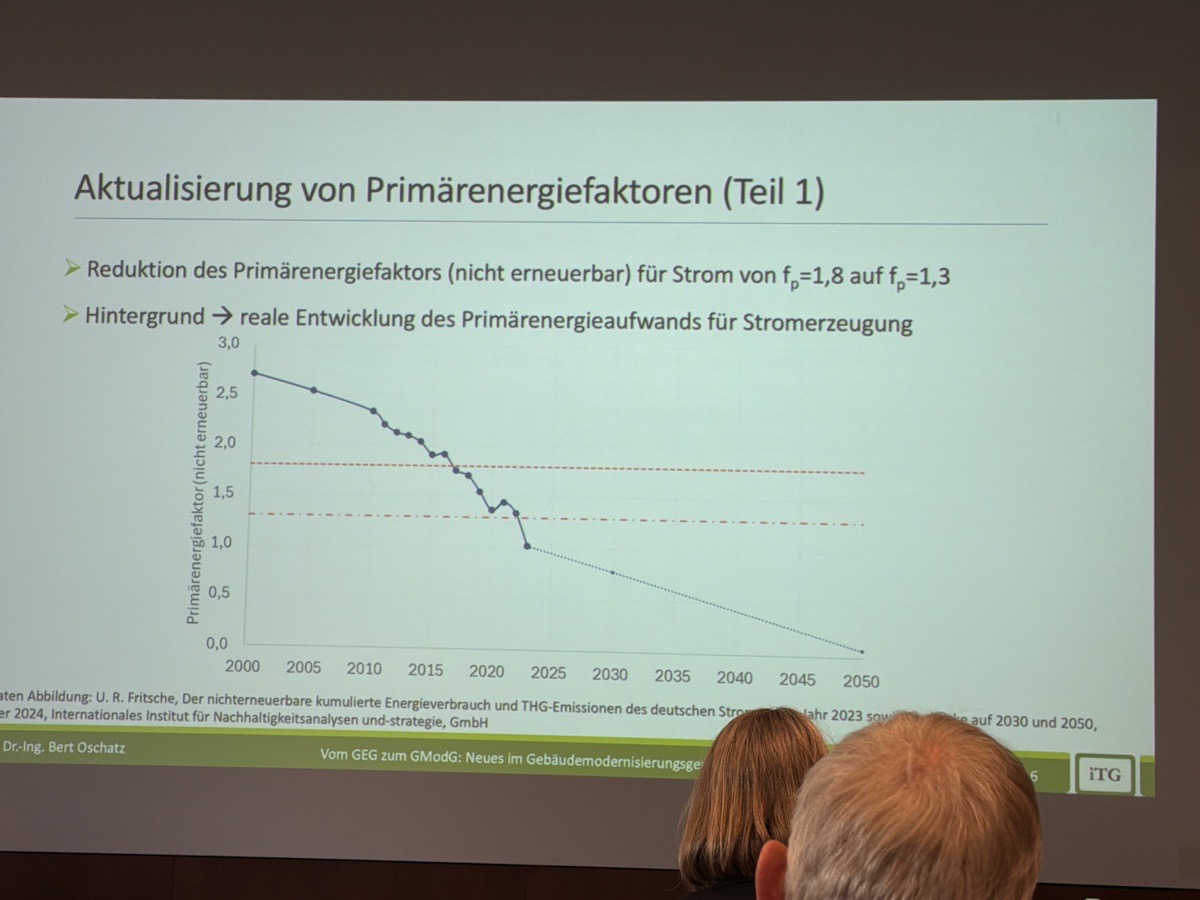
Dr.-Ing. Bert Oschatz (ITG): The primary energy factor for electricity drops from fp=1.8 to fp=1.3 – driven by the increasing share of renewable energy – a decisive lever for evaluating electric heating systems.
New Construction: 100% Infrared as the Most Economical Solution
One of the strongest insights from the conference: In new construction – especially in residential building – pure infrared heating is the most economical solution in many cases. The reasons are obvious:
No boiler room, no piping, no pumps, no chimney. Cost group 400 (building services) accounts for approximately 30% of construction costs. Infrared radically reduces this complexity – and with it, the investment costs.
Several practical projects now convincingly demonstrate this:
| Project | Type | Result |
|---|---|---|
| K76 Darmstadt (2017) | Multi-family, 14 units, 100% IR + 30 kWp PV | Years of operation: EUR 0 maintenance, high tenant satisfaction |
| Fraunhofer IBP Study (2024) | Twin house comparison IR vs. gas | 32% less final energy with infrared |
| Niesky/Goerlitz (2024) | First multi-family building in Saxony with 100% IR | Pioneer project in residential construction |
| Aschersleben | GDR prefab renovation to energy-autonomous | PV + IR as complete concept |
Architect Thomas Lueckgen, who lives in the K76 in Darmstadt himself, puts it succinctly:
"From a cost perspective, this is actually highly attractive for any new building. We now have several years of experience – nothing has broken and no maintenance costs have been incurred."
The concept is particularly convincing in residential construction: Each tenant controls individually, billing is simple, and combined with a rooftop PV system, self-consumption increases significantly.
The Underestimated OPEX Advantage: Operating Costs That Disappear Entirely
What is often overlooked in economic comparisons: The ongoing operating costs (OPEX) of infrared heating are close to zero. No moving parts, no hydraulics, no wear – and therefore no annual maintenance contracts, no chimney sweep costs, no emission measurements.
With conventional heating systems, these items add up quickly:
| Cost Item | Gas/Oil Heating | Infrared Heating |
|---|---|---|
| Heating maintenance (specialist) | 100–200 EUR/year | 0 EUR |
| Chimney sweep & emission testing | 60–120 EUR/year | 0 EUR |
| Metering service & heating cost billing | 100–200 EUR/unit/year | 0 EUR |
| Repair reserves | 100–300 EUR/year | ~0 EUR |
| Total per dwelling unit | 360–820 EUR/year | ~0 EUR |
Particularly relevant for landlords: With decentralized infrared heating, each tenant pays their electricity directly to the energy provider. The entire heating cost billing under the German Heating Cost Ordinance (HeizkostenV) becomes obsolete. No device rental for heat cost allocators, no meter reading fees, no billing preparation by metering services like ista, Techem, or Brunata – costs that typically amount to 100 to 200 EUR per dwelling unit per year with central heating systems.
Over a 20-year period, this means an OPEX saving of EUR 100,000 to 230,000 for a multi-family building with 14 units – money that directly improves the TCO and accelerates the ROI.
Existing Buildings: The Intelligent Interplay of Infrared and Heat Pump
In existing building stock, the optimal solution often looks different. Here, insulation quality is often lower, heating demand higher – and this is precisely where the hybrid approach unfolds its full strength:
| Component | Function | Share |
|---|---|---|
| Heat pump (small-scale) | Base load | approx. 30% |
| Infrared heating | Comfort & peak load | approx. 70% |
The result: Lower investments than a large-scale heat pump, better controllability, and significantly higher flexibility. The heat pump efficiently handles the base load, while infrared heating delivers fast warmth exactly where it's needed.
This interplay is not a compromise – it is the economically and technically superior solution for many existing buildings.
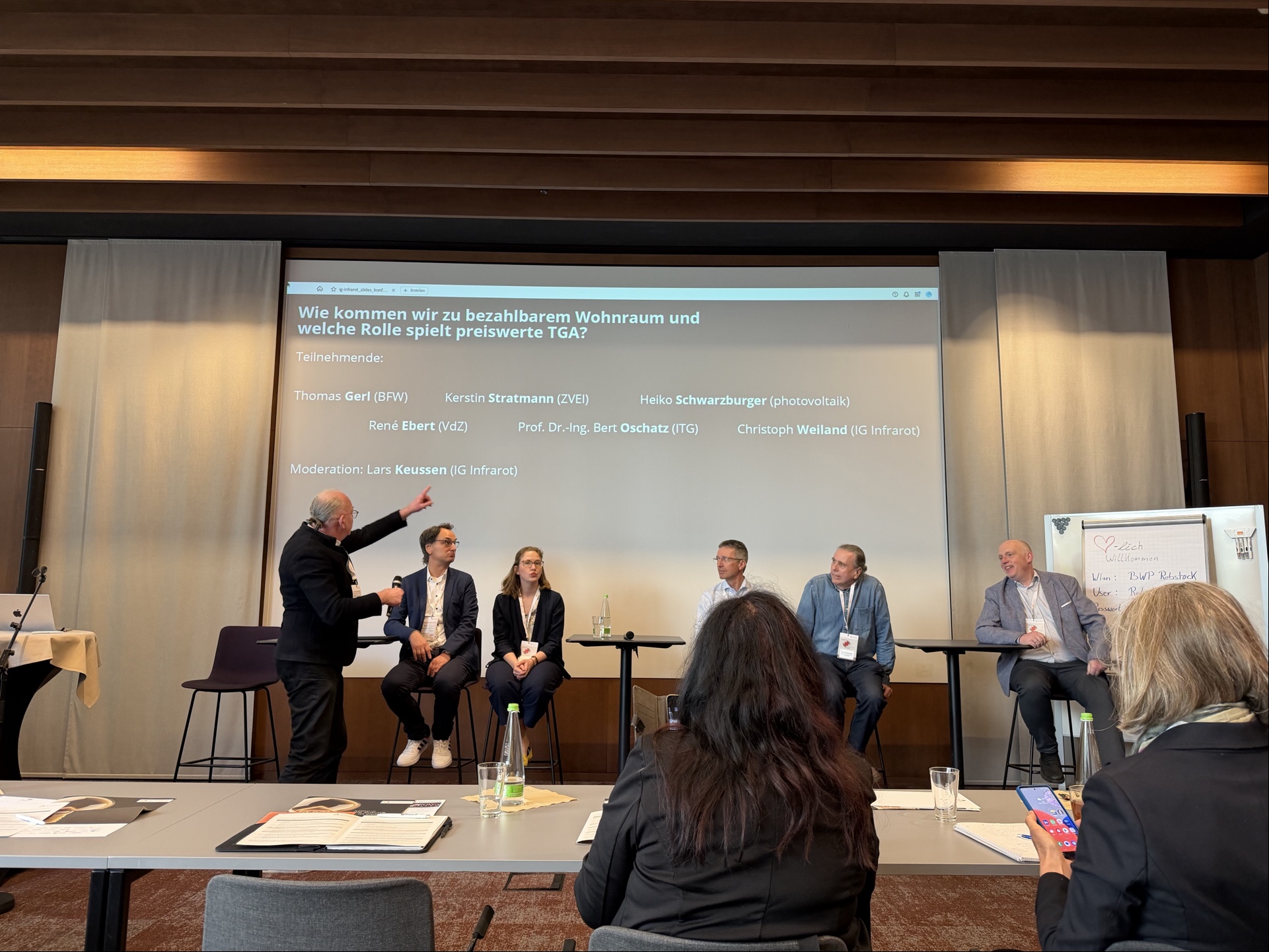
Panel discussion with Thomas Gerl (BFW), Kerstin Stratmann (ZVEI), Heiko Schwarzburger (photovoltaik), Rene Ebert (VdZ), Prof. Dr.-Ing. Bert Oschatz (ITG), and Christoph Weiland (IG Infrarot). Moderation: Lars Keussen.
Why Infrared Is So Strong Within a System
As Heiko Schwarzburger demonstrated in his presentation on IR technology, the systemic advantages are clear:
- Simple as light – no moving parts, no hydraulics, no maintenance
- Cost reduction through mass production achievable
- Fast control through Home Energy Management Systems (HEMS) reduces heat losses
- Minimal risks regarding fire protection, wear, and failure
- Scalable from individual rooms to entire quarters
A typical future setup for buildings:
| Component | Function |
|---|---|
| Photovoltaics (roof + facade) | Power generation |
| Battery storage | Load shifting & self-consumption |
| Electric heating (IR or IR + HP) | Heating without fossil fuels |
| Intelligent control (HEMS) | Real-time optimization |
| Dynamic tariffs | Economic flexibility |
Regulatory frameworks are also opening up: Technology openness is strengthening, the Building Energy Act (GEG) continues to evolve, and the EU operates fundamentally technology-neutral. The market is regaining importance.
Practice Beats Theory – Including Our Own
The most exciting examples in Wuerzburg were real projects:
- Renovations with EUR 600 heating costs per year
- Quarters with massively lower investments compared to conventional solutions
- All-electric concepts with stable operating costs over years
In our own Innovation HUB in Frickenhausen, we've been living this approach for over 13 years – with 62% lower energy costs and zero maintenance costs for heating. On 920 sqm of commercial space with infrared heating, a 70 kWp PV system, and soon a 250+ kWh battery storage for grid-supportive operation.
My Conclusion
These two days have further strengthened my conviction: The future belongs to intelligent interplay – and infrared heating plays a central role in it.
In new construction, often as a 100% solution. In existing buildings, as a strong partner of the heat pump. And always embedded in an overall system of PV, storage, and intelligent control.
What matters is that we make entrepreneurial decisions based on Return on Investment (ROI) and Total Cost of Ownership (TCO) – not primarily subsidy-driven, but economically founded.

My Offer
This is exactly why I developed the QuickCheck. It provides clarity in a short time: What really works? What pays off? What fits the property?
No expert report. No theory. Just a clear basis for decision-making.
Frank Hummel is an entrepreneur, certified advisory board member (Beirat BW), and CEO of the HSG HUMMEL Service Group. He supports companies with strategic decisions in the areas of energy, real estate, and transformation.
Transformation starts with knowledge.
Receive regular analyses, insights and decision-making frameworks on energy, industry and strategic development.
No spam. Unsubscribe anytime. Your data is processed according to our privacy policy.
Connect with Frank Hummel on LinkedIn
For latest insights on energy, electrification and innovation