Infrared Heating for Businesses: Hype or Game Changer?
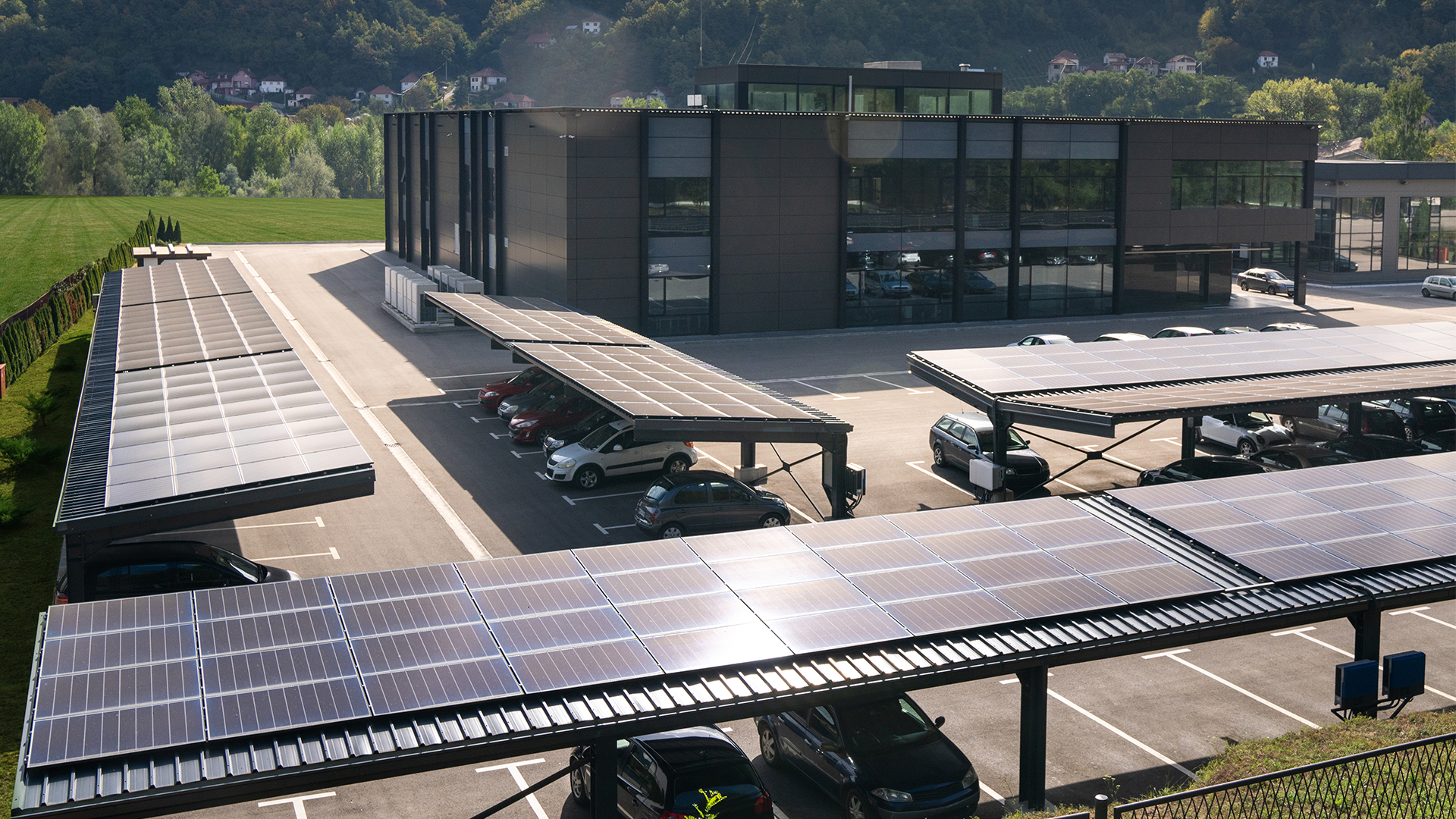
Infrared Heating in Commercial Buildings – Hype or Lever?
17 kWh of heating electricity per square metre per year. What Vitramo demonstrates in multi-party buildings turns the heat pump debate on its head.
At a trade fair recently, I stood at the Vitramo booth and had the figures explained to me. 17 kilowatt-hours per square meter of heating electricity in a multi-party building in Darmstadt – as the sole heating system, without a heat pump, without gas, without underfloor heating. Just infrared panels on the ceiling and a PV system on the roof.
My first thought: That can't be right. My second, after checking the data: This turns some of what we think we know about heating in existing buildings on its head.
What Infrared Heaters Can Do – and What They Can't
Infrared heaters are not a new technology. But for a long time, they were dismissed as "supplementary heating" or a "bathroom solution." That is now changing – for economic, not ideological, reasons.
| Criterion | Infrared Heating | Heat Pump | Gas Condensing Boiler |
|---|---|---|---|
| Acquisition (100 m²) | €4,000–€8,000 | €15,000–€30,000 | €8,000–€15,000 |
| Installation | Simple (electricity) | Complex (outdoor unit, hydraulics) | Medium (gas connection) |
| Maintenance/Year | Practically zero | €200–€400 | €150–€300 |
| Lifespan | 25–30 years | 15–20 years | 15–20 years |
| Operating Costs/Year | Depends on PV | Low (COP 3–4) | Rising (CO₂ price) |
| Eligible for Funding | Indirectly (via PV) | Yes (up to 70%) | No (new construction) |
The figures show: In terms of investment costs, infrared is unbeatable. The acquisition cost is one-third to one-fifth of a heat pump. No outdoor units, no hydraulics, no underfloor heating. A power outlet is enough.
The Vitramo Project K76 in Darmstadt
The multi-family house K76 in Darmstadt is the best-known reference project for infrared heating as the sole heating system. A modern building envelope meeting the applicable EnEV requirements, heat-recovery ventilation, Vitramo ceiling panels and rooftop PV. According to the manufacturer, no specific KfW standard was pursued. After five years of operation, the architect takes stock:
According to the Vitramo brochure, measured electricity consumption for infrared heating in 2022 was 17 kWh per square metre per year. This is a site-specific electricity consumption figure, not a general heat-demand value or a promise for other buildings. For comparison: an average existing building consumes 120 to 150 kWh. Even a KfW-55 new building is at 35 to 40 kWh. Infrared heating in combination with a good building envelope and PV achieves values otherwise only known from passive house brochures.
Residents report high comfort. Infrared radiation does not heat the air, but rather surfaces and bodies directly – similar to solar radiation. The result: comfort at a lower room temperature. 20 degrees Celsius with infrared feels like 22 degrees Celsius with convection.
When Infrared is the Better Solution
Infrared heating is not always the right answer. But in certain situations, it is the clear winner:
In new construction with a good building envelope. If the heating energy demand is below 30 kWh/m², the heat pump becomes overkill. The investment in an outdoor unit, buffer tank, and underfloor heating is disproportionate to the actual heat demand. Infrared plus PV is the most economical solution here.
In existing buildings where a heat pump is not suitable. Old buildings with radiators, without underfloor heating, with limited space for outdoor units. Here, converting to a heat pump is expensive and complex. Infrared panels can be installed room by room and zone by zone – without a construction site.
In commercial properties with intermittent use. Halls, workshops, meeting rooms that do not need to be heated continuously. Infrared reacts in seconds – no lead time, no energy loss from heating up sluggish systems.
The Key: Combination with PV
The Achilles' heel of infrared heating is electricity consumption. Without your own electricity generation, you heat with grid electricity – and that is expensive. But in combination with a PV system, the calculation changes fundamentally.
Anyone who produces electricity in summer and heats in winter needs a storage system – or intelligent energy management. The optimal combination: PV system, battery storage, and infrared heating with smart control. The system preferentially heats when the sun is shining or the storage is full.
Infrared heating is not an alternative to the heat pump. It is an alternative to the entire conventional heating system – if the framework conditions are right.
Conclusion: Not a Hype, but an Underestimated Lever
Infrared heating will not replace the heat pump. But in certain segments – new construction with a good envelope, existing buildings without underfloor heating, commercial buildings with intermittent use – it will become the economically superior solution. Those who ignore this are missing out on money.
My advice: Don't get carried away by the heating debate. Look at the numbers. And if the numbers speak for infrared, have the courage to try it.
Frank Hummel, with REVOLUTION E, advises companies on choosing the optimal heating system – manufacturer-neutral and economically oriented.
Source and unit clarification (15 October 2026): The Vitramo brochure identifies 17 kWh/(m²·a) as measured infrared-heating electricity consumption in 2022 at K76. kWh measures energy; kW measures power. The result depends on the building envelope, heat-recovery ventilation and use. PV annual generation is not the same as simultaneous winter heating coverage. Manufacturer report and original brochure.
Transformation starts with knowledge.
Receive regular analyses, insights and decision-making frameworks on energy, industry and strategic development.
No spam. Unsubscribe anytime. Your data is processed according to our privacy policy.
Connect with Frank Hummel on LinkedIn
For latest insights on energy, electrification and innovation