The Future Is Electric – the Decisive Question Is Economic
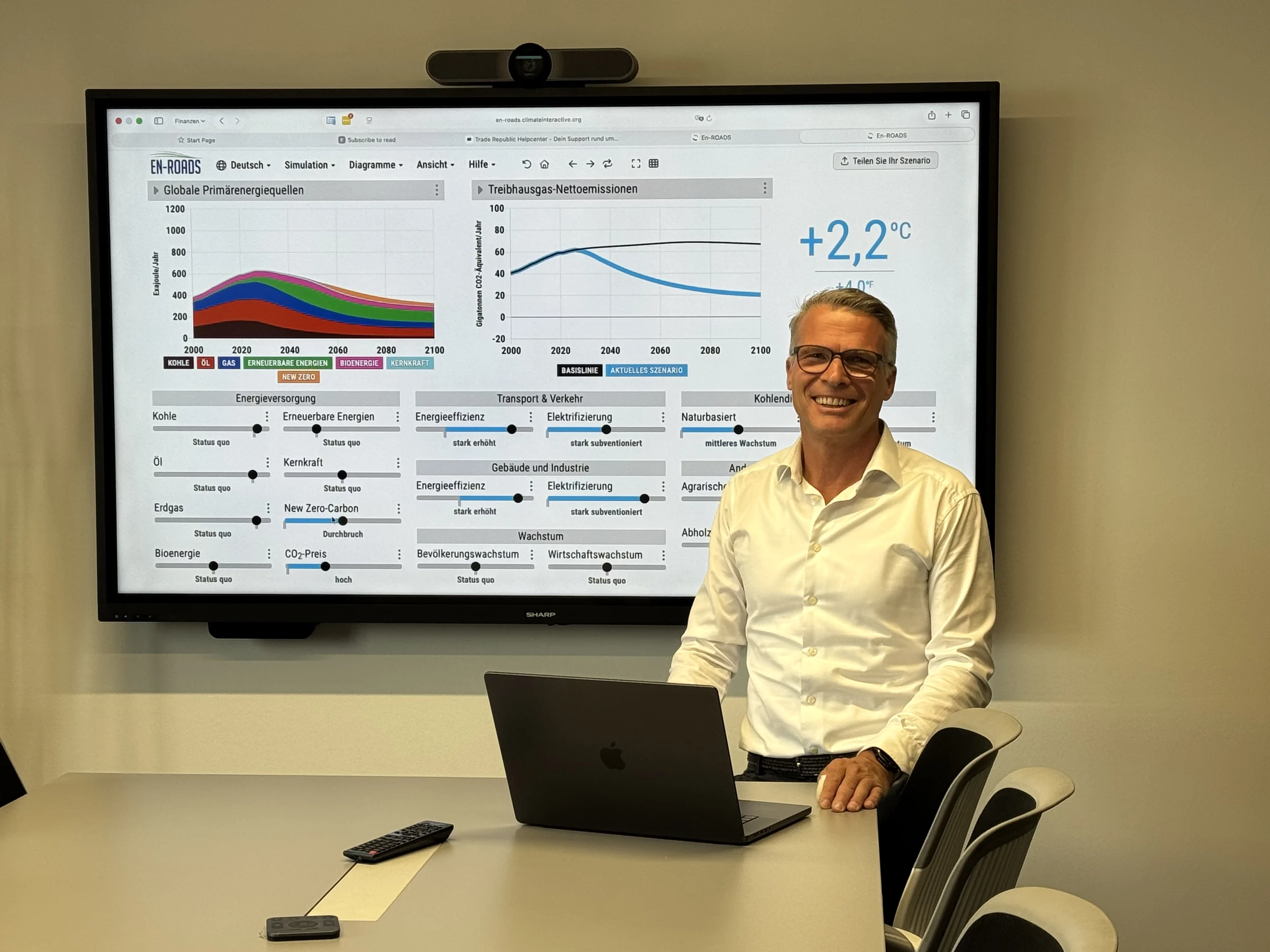
En-ROADS in a workshop: every slider shows how a decision plays out across the whole system.
The international climate debate is often shaped by political demands, bans and competing interests. For business leaders, the question is a different one: which decisions do we need to make today so that our companies are still competitive in ten or twenty years?
COP31 in Antalya ended on 22 November without a joint final pact. Countries remained divided above all on fossil fuels. At the same time, around 80 countries voluntarily backed a concrete goal: by 2035, 35 percent of final energy consumption should come from electricity. 3
As a certified En-ROADS Climate Ambassador, I took part in Climate Interactive's COP31 debrief on 24 November: "COP31 Reflections: From Pledges to Implementation in En-ROADS". 2 The outcomes of the conference were run live in the En-ROADS simulator – asking what the pledges actually deliver once they are implemented. Several of the findings are highly relevant for business leaders.
The transformation is already happening
I consider "35 by 35" the right level of ambition. According to the En-ROADS simulations presented, the share of electricity would already rise to around 31 percent without any additional measures.
Electrification is no longer just a politically driven process. It increasingly follows an economic and technological logic.
Electric mobility, photovoltaics, battery storage, electric process heat and smart energy management already allow companies to use energy more efficiently and reduce their dependence on fossil fuels. The energy crisis of recent months has shown once again how quickly this can matter.
Technology is not the bottleneck
One finding stayed with me in particular: in the scenario examined, additional technological breakthroughs change the global temperature by 2100 by only around 0.02 degrees.
The technology is largely there. The challenge is implementation.
For companies, this means: anyone waiting for the next technological revolution is leaving the economic potential of today's available technology on the table.
This is not about deploying every new technology. It is about combining the right technologies at the right time in an economically sound way.
What really works in the model – and what it means for a business
Climate Interactive derived clear priorities from the simulations: no new fossil infrastructure, phasing out fossil subsidies, improving energy efficiency, establishing a carbon price and starting the phase-out of fossil fuels.
These are policy levers. But inside a company, they have a direct equivalent:
- No new fossil lock-in: every new gas boiler, diesel fleet or fossil process plant ties a company down for 15 to 30 years.
- Efficiency first: the kilowatt-hour I don't need is one I don't have to generate, store or pay for.
- Carbon price as a fixed parameter: anyone calculating an investment today should treat rising carbon costs as a realistic scenario – not as a footnote.
Investment decisions create long-term dependencies
Buildings, production plants and energy infrastructure often have service lives of several decades.
Anyone investing in fossil infrastructure today is also deciding on part of their future operating costs, their dependence on international energy markets and their regulatory risks.
So the decisive question is not just: what does the investment cost today?
It is: which risks and which opportunities arise over its entire service life? That requires a sound view of TCO, IRR and DSCR – not just a comparison of purchase prices.
Store CO₂ or avoid emissions?
Carbon capture and storage (CCS) is also intensely debated.
In its COP31 analysis, Climate Interactive reaches a clear conclusion: even scaling up to 1.3 to 2.5 gigatonnes of CO₂ per year by 2035 is unrealistic and would have little effect on global temperature. CCS is classified there as a distraction rather than a solution.
My view is somewhat more nuanced. For hard-to-abate industrial emissions or the permanent storage of carbon from biomass, the technology can play a complementary role.
From an economic perspective, however, the first question should always be whether it makes more sense to treat emissions afterwards with additional technical and energy effort – or to avoid them from the start. In the vast majority of cases, avoiding them is the cheaper calculation.
A missed climate target is no excuse for standing still
Even the most ambitious scenarios in the En-ROADS analysis presented initially exceed the 1.5-degree limit. Warming peaks at around 1.8 degrees and then settles at about 1.7 degrees.
That is not an argument against the transformation. The best possible pathway is still clearly better than business as usual.
The more we limit climate damage, energy dependencies and economic risks, the greater the long-term benefit – for every single company as well.
Entrepreneurial responsibility means thinking ahead
As an entrepreneur and sparring partner, I don't see my role as representing political positions or telling companies which technologies to use.
What matters to me is recognising developments early, honestly questioning existing business models and assessing different future scenarios economically.
En-ROADS is a good basis for this. 1 The simulator makes complex relationships visible. And it shows very quickly which decisions have real impact and which only sound good. I also use it in workshops with management teams and leadership groups.
Strategic decisions should come neither from fear nor from ideology, but from a clear understanding of economic and technological relationships.
Politics did not agree on a common path in Antalya. Business leaders don't need to wait for it.
The future cannot be predicted exactly. But we can prepare our companies for it.
More on the economic perspective of COP31: Climate Policy Has Long Been Economic Policy
Basis and note: Climate Interactive, "COP31 Reflections: From Pledges to Implementation in En-ROADS" (webinar of 24 November 2026) and the key takeaways presented there. The figures quoted are scenario-dependent simulation results of the En-ROADS model, not forecasts. The assessment for companies is my personal view.
References
Connect with Frank Hummel on LinkedIn
For latest insights on energy, electrification and innovation