Bidirectional Charging: Your EV Becomes a Power Plant
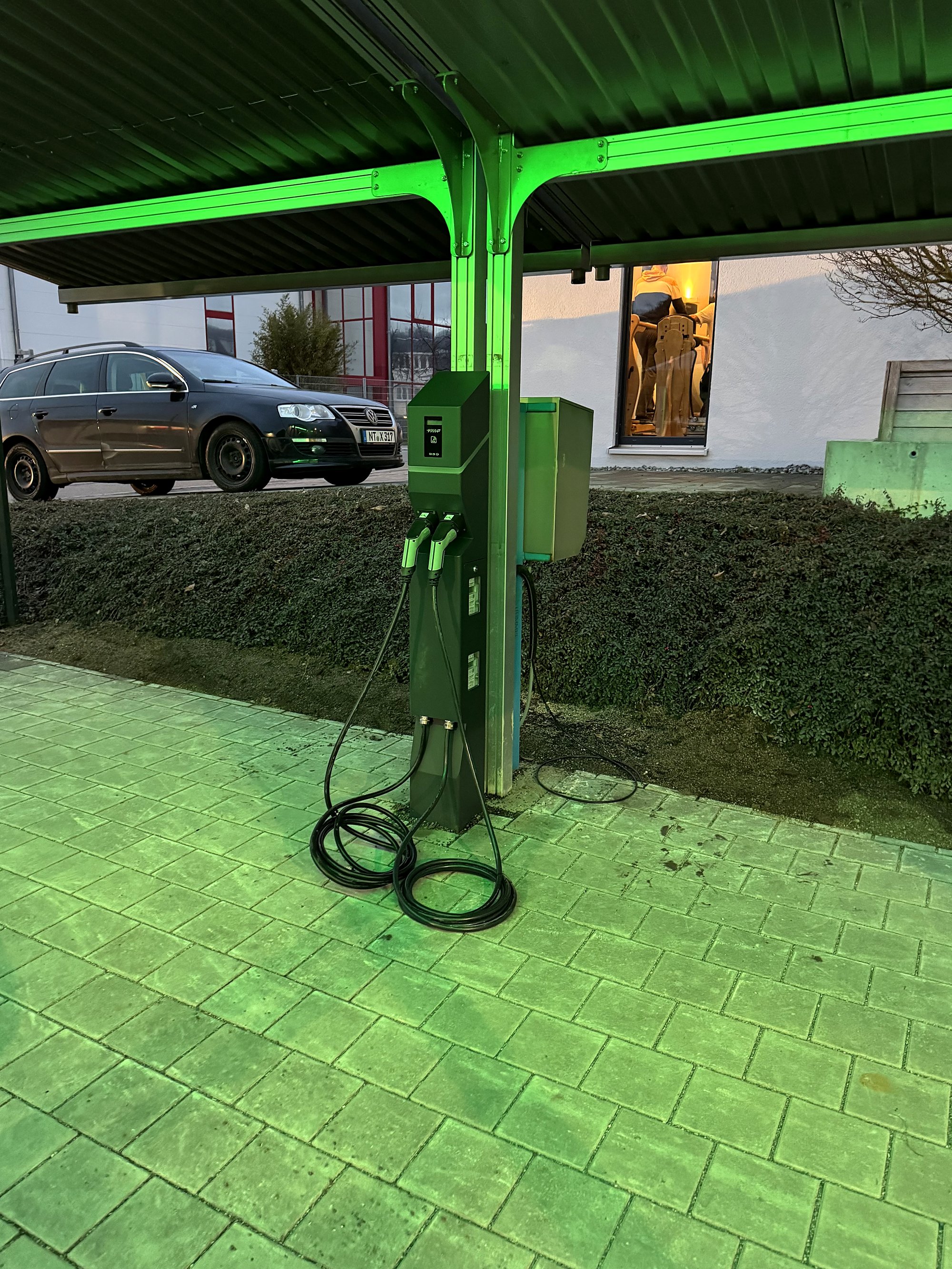
Bidirectional Charging: Why Your EV Will Soon Be Your Power Plant
Vehicle-to-Grid is no longer a futuristic concept. From 2026, it will become economically viable in Germany for the first time.
Imagine this: Your ten company vehicles are parked overnight in the company yard. Instead of just consuming electricity, they feed energy back into the building or the grid. In the morning, they are fully charged, and you've earned money overnight – instead of spending it on grid power.
This is not science fiction. This is Vehicle-to-Grid (V2G) – and in 2026, it will become economically feasible in Germany for the first time.
What Bidirectional Charging Means
Bidirectional charging means that electricity not only flows into the battery but also out of it. Depending on the application, there are three variants:
| Variant | Abbreviation | Power Flow | Application |
|---|---|---|---|
| Vehicle-to-Home | V2H | Car → Building | Self-consumption, emergency power |
| Vehicle-to-Building | V2B | Car → Commercial Building | Peak shaving, PV storage |
| Vehicle-to-Grid | V2G | Car → Power Grid | Grid stabilization, arbitrage |
V2H is the simplest variant: Your EV supplies your home with electricity when needed – for example, during a power outage or if the PV system doesn't supply enough. V2B extends this to commercial buildings: The company vehicle becomes a mobile battery storage that absorbs expensive load peaks. V2G is the supreme discipline: The car actively feeds into the power grid and is remunerated for it.
What Changes in Germany in 2026
Until now, bidirectional charging in Germany was economically unviable. The reason: the double grid fee burden. Anyone who charged electricity from the grid into their car and then fed it back in paid grid fees twice. This destroyed every business model.
That changes in 2026. The amended Energy Industry Act will treat EVs like any other storage system. The double grid fee penalty will be abolished. This will make V2G economically viable for the first time – and significantly so.
Calculation Example: 10 EVs as Company Storage
Let's take a medium-sized company with 10 EVs, each with a 60 kWh battery. Of these, 80 percent are available in the evening – so 8 vehicles with a total of 480 kWh of usable capacity. Realistically usable for V2B/V2G: 50 percent, i.e., 240 kWh.
| Parameter | Value |
|---|---|
| Vehicles available (evening) | 8 out of 10 |
| Total capacity | 480 kWh |
| Usable for V2B/V2G (50 %) | 240 kWh |
| Peak load avoidance | 20–40 kW |
| Saved peak load costs/month | 800–1,600 € |
| Arbitrage earnings (exchange price difference) | 200–500 €/month |
| Annual added value | 12,000–25,000 € |
These are conservative estimates. With increasing volatility of electricity prices – and this increases with the expansion of renewables – arbitrage earnings will continue to rise.
Which Vehicles and Wallboxes Can Do It?
In 2026, the first production-ready bidirectional solutions will come onto the market. Volkswagen has announced V2H for the ID.7 and ID.Buzz. Hyundai and Kia already offer V2L (Vehicle-to-Load) with their 800-volt platform. BMW, Mercedes, and Ford are working on V2G-capable models.
For wallboxes, it will be exciting: Enphase is bringing the IQ Bidirectional EV Charger into series production – a DC-based charger that communicates directly with the home grid and the PV system. The Mobility House offers ChargePilot, a software platform that intelligently controls V2G fleets.
Why Companies Should Plan Now
Bidirectional charging will not happen overnight. It requires compatible vehicles, certified wallboxes, an energy management system, and – for V2G – a contract with an aggregator or direct marketer. This requires a lead time of 12 to 18 months.
Those who plan now will be operational in 2027. Those who wait will watch others reap the arbitrage earnings.
Your company vehicles are not just means of transport. They are mobile battery storage units with 60 kWh capacity. The question is not whether you use it – but when.
Conclusion: The Car as a Power Plant is No Longer a Vision
Vehicle-to-Grid will change the way companies think about their fleet. Not as a cost center, but as an energy asset. The regulatory hurdles will fall in 2026. The technology will arrive in 2026/27. The economic viability is given.
My advice: Talk to your energy consultant now about V2G readiness. Check which vehicles in your fleet are or will be bidirectionally capable. And plan your charging infrastructure so that it can be retrofitted.
Frank Hummel with REVOLUTION E advises companies on the integration of electromobility, charging infrastructure, and energy management – from strategy to implementation.
Transformation starts with knowledge.
Receive regular analyses, insights and decision-making frameworks on energy, industry and strategic development.
No spam. Unsubscribe anytime. Your data is processed according to our privacy policy.
Connect with Frank Hummel on LinkedIn
For latest insights on energy, electrification and innovation