When Government Steers the Market – and Loses Course

Germany’s national fast-charging network was intended to become one of the country’s flagship infrastructure projects for electric mobility: more than 1,000 locations, around 9,000 high-power charging points and approximately €2.3 billion in federal funding.1
The rationale was understandable. A nationwide network would close remaining gaps and provide the confidence required for more consumers and businesses to switch to electric mobility.
Yet a recent report by The Pioneer paints a sobering picture. Of 900 planned regional locations, only 262 were reportedly open in early September 2026, with another 36 under construction. More than 600 would therefore still need to be completed by 2030.2
For me, this is not an argument against electric mobility. Quite the opposite. It is an argument for better, more consistent and more market-driven execution.
Electric Mobility Is a Chicken-and-Egg System
Electric vehicles and charging infrastructure cannot be scaled independently.
Consumers and businesses are more likely to choose electric vehicles when charging is reliable, convenient and economically predictable. Operators, in turn, will invest sustainably only when there are enough vehicles and a credible path to commercially viable utilisation.
Both sides therefore need to grow in step.
This is where the challenge becomes visible. The BDEW reported more than 200,000 public charging points by the end of 2025, but average simultaneous utilisation was only twelve per cent.3 More infrastructure alone does not create a functioning market.
When political targets, purchase incentives and transition periods are repeatedly changed or reopened for debate, demand shifts. Consumers wait. Fleet operators postpone decisions. Vehicle manufacturers adjust their plans. Charging operators lose confidence in when and where their investments will pay off.
Fewer vehicles mean lower utilisation. Lower utilisation makes further charging investment less attractive. A weaker charging offer then slows vehicle adoption again.
That is the chicken-and-egg dilemma. It cannot be solved through a sequence of isolated funding programmes. It requires a credible target operating model and a course that survives election cycles.
Public Funding Can Help. It Must Not Replace the Market.
Government has a legitimate role in enabling infrastructure ahead of demand. Some locations may be economically important even though they do not yet support a viable business case. Temporary start-up funding, standards and targeted risk-sharing can be appropriate.
The problem begins when the subsidy becomes the business model.
According to The Pioneer, TotalEnergies was awarded 134 Deutschlandnetz locations and could receive up to €152 million over at least eight years. The company is now reportedly seeking to sell its German charging business. At the time of the report, 47 of the 134 locations were operational.2
That is one specific corporate and project case. But it raises a broader question:
What remains of an infrastructure strategy when a major participant changes direction – and the market still does not see an attractive price for the package?
The answer is not to question electric mobility. It is to make the funding architecture, lot sizes, accountability and commercial incentives more resilient.
The Mittelstand Needs Access – Not Only Subcontractor Roles
It would be inaccurate to say that small and mid-sized companies never receive public funding. But large project lots, complex procedures, substantial guarantees and long pre-financing periods can make access materially more difficult.
That is a missed opportunity.
Regional electrical, energy and technology companies often understand local buildings, distribution grids, permitting processes and customer requirements better than anyone else. They can integrate charging infrastructure with photovoltaics, battery storage, load management and building automation. That systems capability is exactly what the market needs.
When programmes are structured at a scale and level of complexity that only major corporations or consortia can realistically handle, concentration increases. The Mittelstand remains in the subcontractor role even though it often carries much of the local execution capability and delivery risk.
Germany’s Federal Cartel Office has confirmed broader competition deficiencies in the public charging market. It calls for transparent, time-limited and non-discriminatory allocation processes and explicitly states that lot size and structure are critical to supplier diversity and competition.4
The distinction matters: the authority views the Deutschlandnetz tender in principle as an instrument that can improve open market access. The issue is therefore not government involvement itself. The issue arises when implementation weakens speed, competition and private investment appetite.
A Charging Station Is Not an Isolated Product
Germany still focuses too heavily on unit counts: how many charging points were ordered, funded or opened?
The economics of a location depend on different questions:
| C-Level Question | Commercial Relevance |
|---|---|
| Where will real demand emerge? | Utilisation, revenue and break-even timing |
| What grid capacity is available? | Connection cost, delivery time and scalability |
| How will PV and storage be integrated? | Energy cost, peak demand and resilience |
| Which vehicles will charge, and when? | Sizing, charging power and operating model |
| Which trigger releases the next expansion stage? | Capital employed, IRR and overbuild risk |
A charging station is part of a system comprising land, grid connection, on-site generation, storage, intelligent load management, billing and, increasingly, bidirectional charging. Installing hardware alone does not create a sustainable business model.
Economics Before Subsidies
I have seen many projects begin with the wrong question: Which subsidy is available? Only later does someone ask: Do we actually need this solution – and will it remain viable?
The sequence should be reversed.
Start with demand, operating scenarios, TCO, investment stages, IRR and risk. Then assess whether public funding can sensibly accelerate an already credible path.
A subsidy can improve a sound business case. It cannot cure a weak one.
Infrastructure with long investment horizons must still work when forecasts are revised downwards, a funding scheme expires or a partner changes strategy.
We Hold Course – and Deliver Ourselves
For all the criticism of public programmes, one point matters greatly to me: we do not comment on this topic from the sidelines. For more than three decades, we have designed, built and operated energy, building and infrastructure systems under our own responsibility. At our HSG site, we demonstrate what an integrated system looks like in practice.
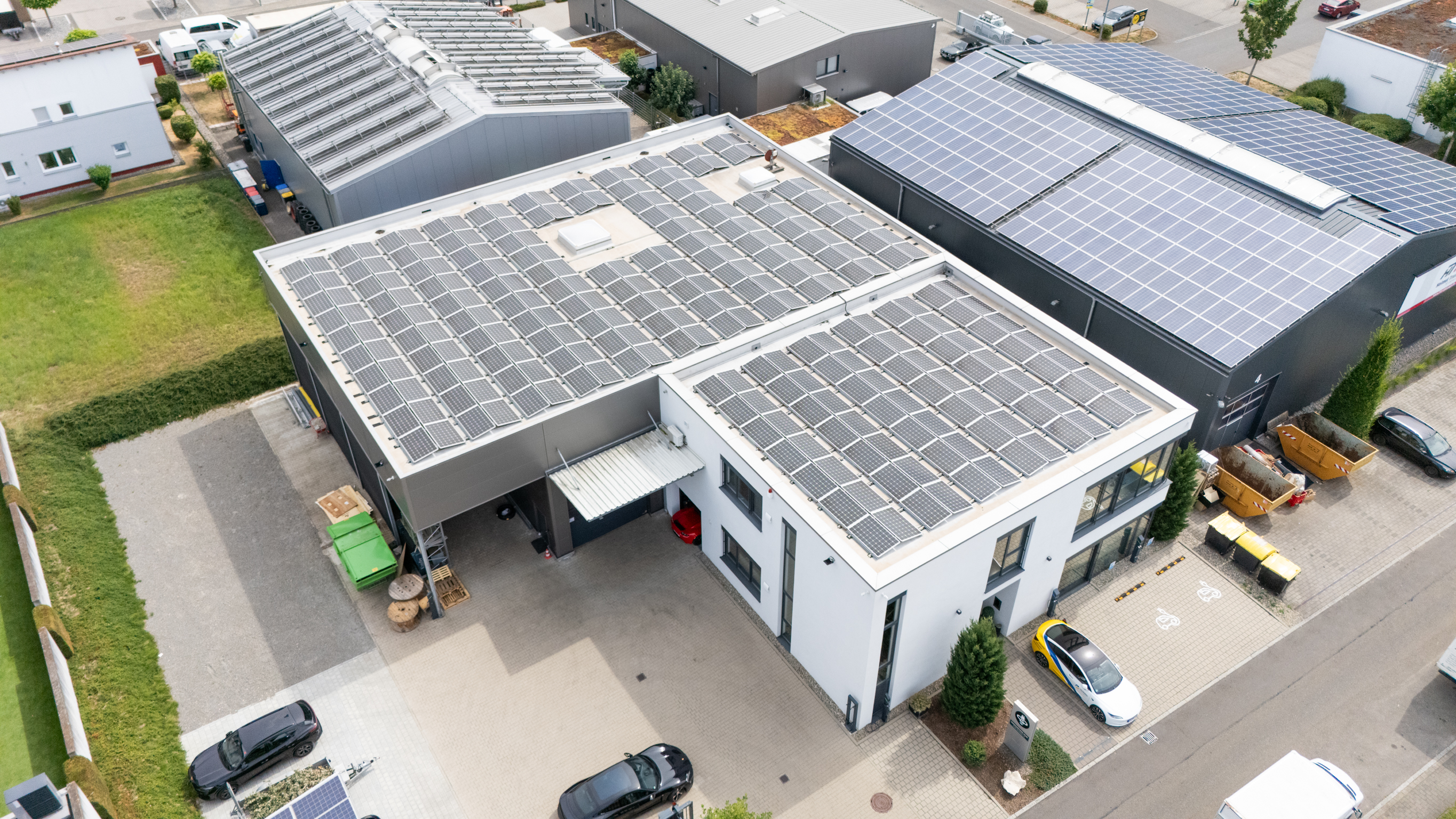
Our HSG site: photovoltaics as part of an integrated energy and mobility system.
The photovoltaic system generates electricity directly on site. That energy can serve the building, charge the stationary battery or supply vehicles through the AC and DC charging infrastructure. Intelligent energy management coordinates building demand, generation, state of charge and vehicle requirements.
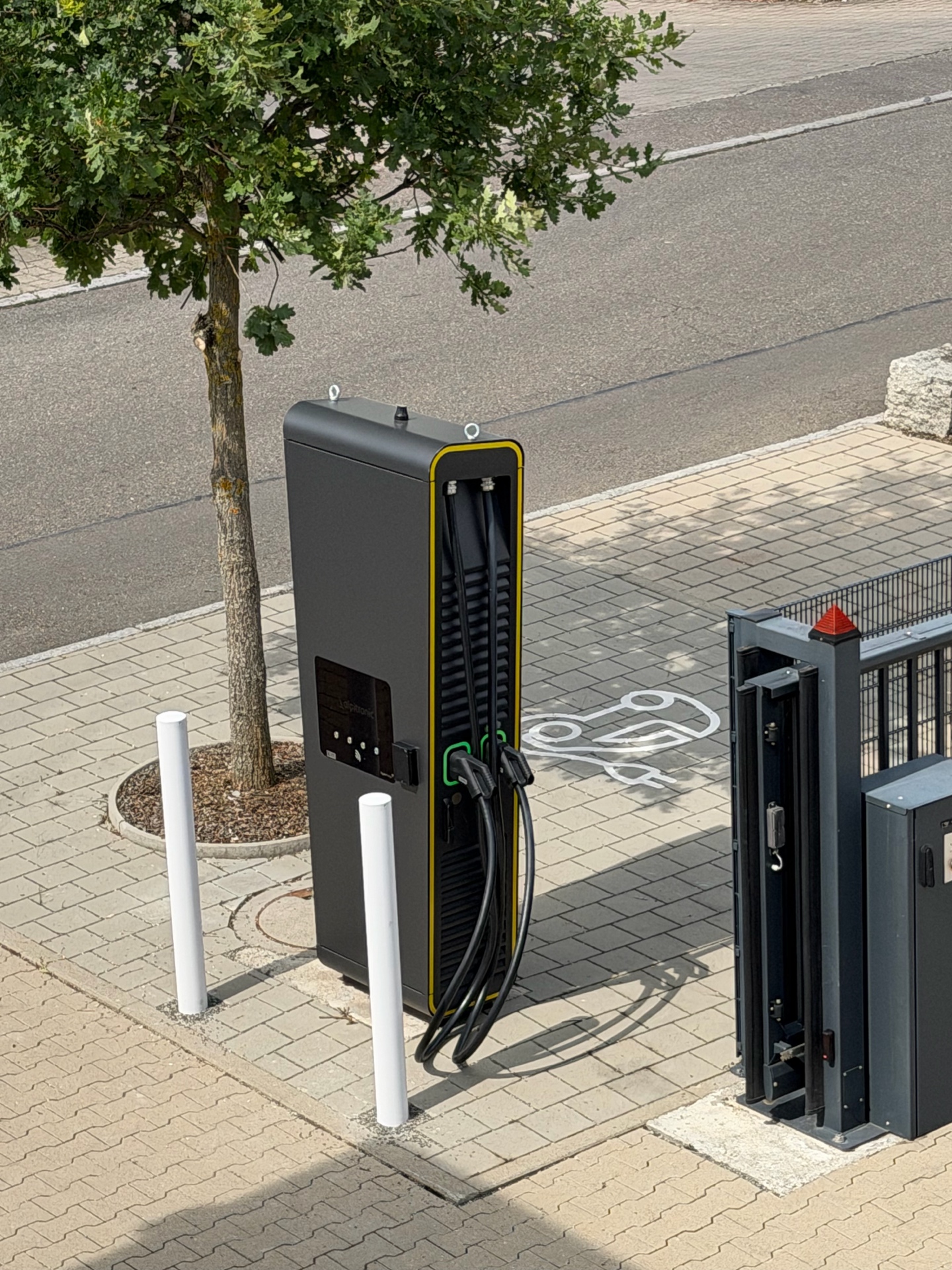
AC and DC charging for company vehicles, employees, visitors and public charging.
The DC charger does not have to draw its full output rigidly from the grid in every situation. The battery acts as a power buffer: it can provide additional energy when required, reducing peak loads and additional grid draw. This is not a claim of complete grid neutrality. It is a real-world system designed to use available grid capacity more intelligently and economically.
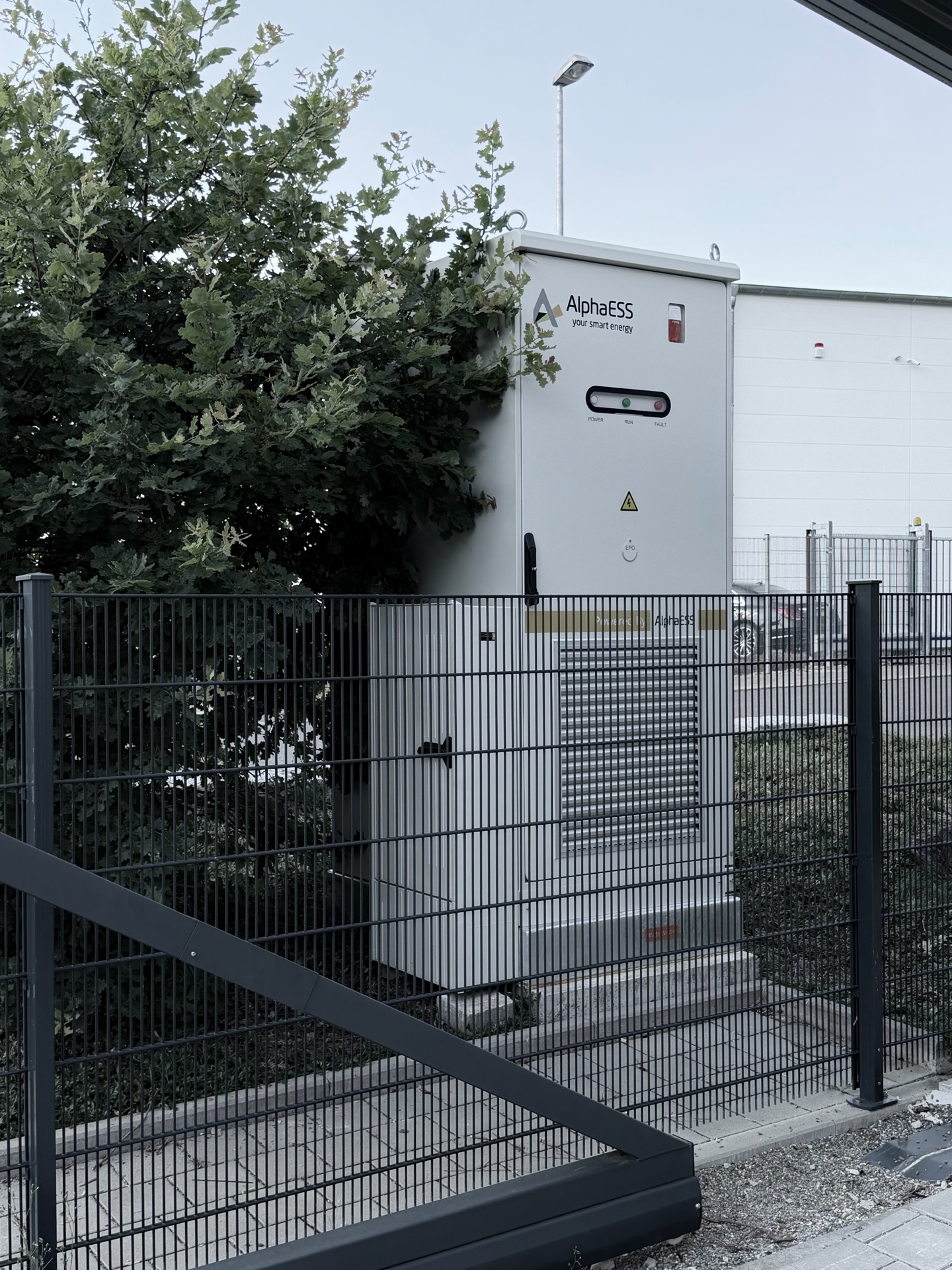
The stationary battery integrates self-consumption, load management and high-power DC charging.
We implemented the battery and the DC charger without public funding. The system is nevertheless economically viable for the company and can also support public charging. Not because every individual component delivers a spectacular standalone business case, but because generation, building demand, storage, charging requirements and utilisation were designed as one system.
That is what economics before subsidies means to me: first assess energy flows, utilisation, TCO, investment stages and risk. Then make the decision. Public funding can accelerate delivery, but it must not be the condition that makes a technically or economically questionable solution appear viable.
We do not merely talk about transformation. For more than three decades, we have held course, invested our own capital and delivered.
No two sites are identical. But the principle is transferable: generate locally, store intelligently, limit peak demand, provide charging power according to actual need and expand in modules only when utilisation and the business case support the next step.
Five Lessons for Policymakers and Business Leaders
| Principle | Consequence |
|---|---|
| System before isolated measure | Plan vehicles, charging points, grids, sites and energy supply together. |
| Course stability before activism | Establish a ten-year target model instead of reopening direction after every debate. |
| Milestones instead of speculative full build-out | Expand capacity in modules when utilisation and vehicle numbers cross defined thresholds. |
| Competition instead of dependency | Structure lots, interfaces and tenders so the Mittelstand can genuinely participate. |
| TCO before headline subsidy | Measure success through availability, utilisation and economics – not only approved funds or installed units. |
What Happens When You Fail to Hold Course
Transformation is not a funding programme. It is the long-term redesign of markets, infrastructure and business models.
Funding charging infrastructure today, unsettling vehicle demand tomorrow and launching another programme the day after does not create a resilient market. It creates dependency on the next subsidy.
The Deutschlandnetz therefore illustrates a broader weakness in German economic policy: we often think in programmes, funding pots and jurisdictions, but too rarely in integrated systems, investment logic and long-term reliability.
Electric mobility will continue to grow. The decisive question is whether Germany will build its own value creation, innovation and a strong Mittelstand around it – or spend substantial sums without creating a sustainable market.
That requires fewer changes of direction, fairer competitive conditions and greater trust in those prepared to invest their own capital and accept entrepreneurial responsibility.
Transformation does not succeed through a constant stream of announcements. It succeeds when a credible course is set – and held.
Planning charging infrastructure or electrification and need a robust decision basis? Let us talk.
Sources
Transformation starts with knowledge.
Receive regular analyses, insights and decision-making frameworks on energy, industry and strategic development.
No spam. Unsubscribe anytime. Your data is processed according to our privacy policy.
Connect with Frank Hummel on LinkedIn
For latest insights on energy, electrification and innovation