Why our electricity is so expensive — and what the energy transition has to do with it

On the evening of 23 November 2026, my dynamic electricity tariff showed 54 euro cents per kilowatt-hour. The prices displayed for the night barely fell below 40 cents either. Numbers like these make me look more closely. Where does the price come from? And what does it mean for businesses that need to budget their energy costs for years ahead?
The discussion quickly turns to the energy transition. Too little wind, too much solar, expensive grids. Part of the explanation also lies in the markets where we buy our fuels.
When gas influences electricity prices
Electricity exchanges match available offers with demand. In simple terms, the last offer needed to meet demand shapes the price in the relevant auction. This is the merit-order principle. When wind and solar generation are low, gas-fired power stations can play an important role. Their fuel costs then feed into electricity prices. 1 2
Gas does not determine the price in every quarter-hour. Demand, available power stations and trade with neighbouring countries also matter. ACER describes how additional solar generation pushes daytime prices down, while gas remains relevant during evening peaks and periods of low renewable output. 2
I keep three figures separate: my personal tariff display, the wholesale electricity price and a power station’s fuel costs. The 54 cents shown under my contract are a personal observation, not a general market price.
Pure spot/day-ahead wholesale electricity prices exclude grid charges, taxes, duties, levies and other supply costs. They are neither customer retail prices nor the gas-generation fuel costs calculated below. 1
What more expensive gas means in a calculation
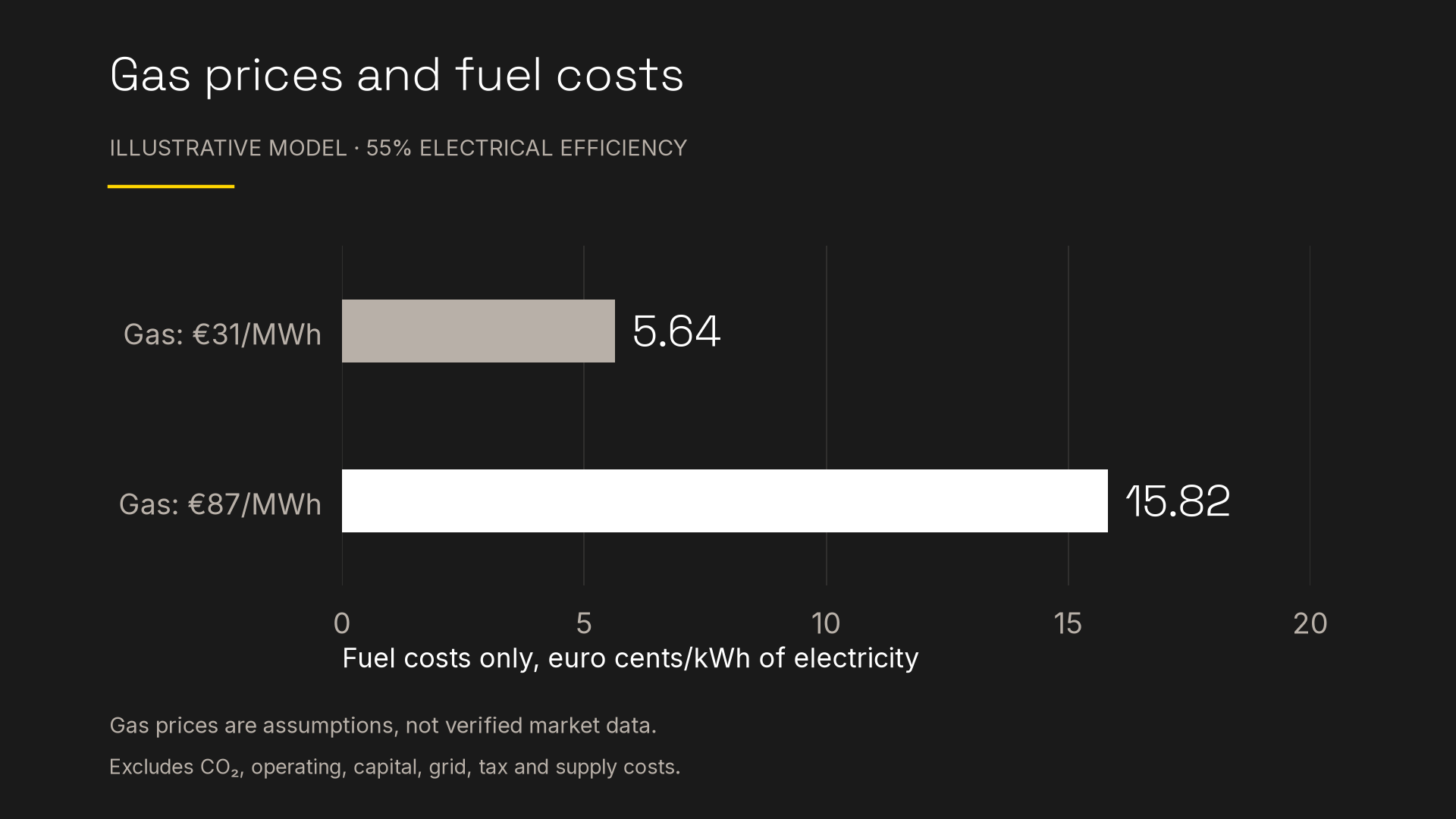
A simple model makes the relationship tangible. I use assumed gas prices of €31 and €87 per megawatt-hour. These are explicitly illustrative inputs, not verified monthly or daily market prices.
At an assumed electrical efficiency of 55%, fuel costs alone increase from about 5.64 to 15.82 euro cents per kilowatt-hour of electricity. The difference is 10.18 euro cents per kilowatt-hour.
 Enlarge chart
Own calculation: gas price divided by electrical efficiency, converted from euros/MWh to euro cents/kWh. Price and efficiency use the same calorific-value basis. CO₂ allowances, other operating and start-up costs, investment, financing, grid charges, taxes and supply costs are excluded. This chart does not show an actual wholesale or retail electricity price.
This does not tell us how much of a particular electricity price increase was caused by gas. It does show how strongly a gas-fired power station’s fuel costs respond to changing gas prices.
LNG connects our supply to the global market
Liquefied natural gas, or LNG, makes it possible to import gas by ship. Natural gas is cooled to around minus 162 degrees Celsius, transported and converted back into gas at its destination. This supply chain requires infrastructure, energy and transport capacity. 3
It opens up additional sources of supply. At the same time, Europe participates in a global market. Where contracts allow flexible destinations, LNG cargoes can serve different markets. European buyers then also compete with customers in Asia. Weather, supply disruptions and geopolitical conflicts can intensify this competition. 4
In its latest gas security review, the IEA warns of additional price risks from low European storage levels and competition for flexible LNG cargoes. More suppliers create additional options. They do not secure a stable price. 4
On-site generation changes the cost risk
Solar PV and wind power require capital. Equipment, maintenance, financing and infrastructure all have to be paid for. Once the assets are built, however, there is no ongoing fuel purchase for sunshine or wind. This removes a price risk that fossil generation continues to carry. 1
Availability remains weather-dependent. A sound business assessment therefore also asks when we need the electricity. A midday surplus has limited value if most of our demand occurs in the evening.
Storage, controllable loads and flexible operating schedules can help match generation and consumption. Grids and dependable available capacity also belong in the calculation. ACER identifies this flexibility as a key element of a more efficient energy system. 2
Every investment at an individual site needs a sound business case. A battery makes sense when its specific benefits justify its total costs. The same applies to solar PV, heat supply or a change in electricity procurement. Subsidies can help. The assets’ operating economics must provide the foundation.
Energy costs belong on the executive agenda
I see the energy transition as a matter of business risk management too. When we plan buildings, equipment or a site for ten or twenty years, we also decide which future dependencies to accept.
That calls for an honest comparison. What will the transition cost, including grids, storage and dependable supply? Which price and supply risks remain? And which costs will we continue to carry if we keep our current arrangements unchanged?
In an executive discussion, I would focus on three questions. How sensitive are our margins to higher energy prices? Which investments create the greatest economic benefit under realistic assumptions? And how robust is the decision if prices become less favourable, capital requirements increase or utilisation falls?
A useful decision basis shows total costs over the assets’ lifetime and several plausible scenarios. That gives us priorities, investment steps and an acceptable level of risk.
For me, the goal is to make energy costs more predictable and preserve our ability to act as a business.
If you would like to put these questions into context for your business, buildings or property portfolio, we can discuss them through SPARRING & ADVISORY BOARD.
References
- 1.German Federal Ministry for Economic Affairs: Electricity prices – merit order and price components
- 2.ACER: Key developments in European gas and electricity markets, March 2026, especially pages 29–30 and 41–42
- 3.U.S. Energy Information Administration: Natural gas explained – Liquefied natural gas
- 4.IEA: Low storage buffers in Europe could prolong global gas market tightness well into 2027, 3 November 2026
Connect with Frank Hummel on LinkedIn
For latest insights on energy, electrification and innovation