Robotics in Mid-Sized Companies: From Potential to a Robust Business Case
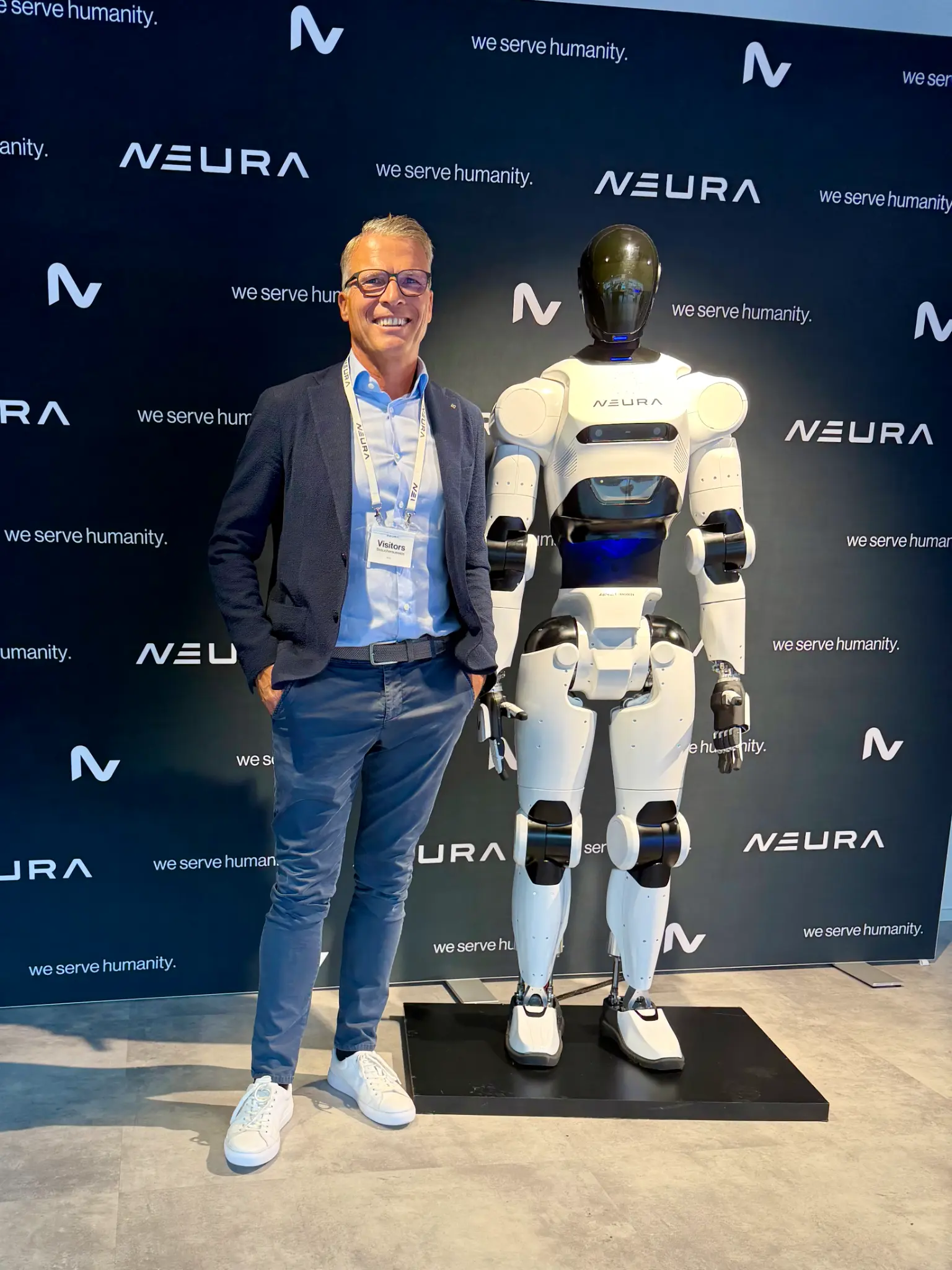
A humanoid robot immediately attracts attention. You see the movement, the sensors and the possibilities – and the future suddenly feels very close.
That sense of excitement was tangible during my visit to NEURA Robotics. Cognitive robots are designed to perceive their surroundings, respond to change and collaborate more safely with people. From a technology perspective, that is impressive.1
For business owners, however, the real work starts after that first impression.
The decisive question is not: What can this robot do? It is: Which specific bottleneck will it solve in my company – reliably, as part of the existing operation, and with a sound business case?
The robot is not the business case. The process it improves is the business case.
Fascination Is the Starting Point – Not the Investment Decision
New technologies can easily draw attention to the visible product. A robot picks up a component, recognises its environment or responds to voice commands. It looks like a ready-made solution.
In practice, it is only one part of a larger system.
A robot does not automatically improve an unclear or unstable process. It needs a defined use case, suitable tools, available data, safe operating procedures and a clean connection to the existing organisation. Without that groundwork, fascinating hardware can quickly become an expensive stand-alone solution.
The same applies to robotics, digitalisation, energy and artificial intelligence: technology does not replace clarity.
The Use Case Comes Before the Technology
Not every process requires a humanoid robot. For a stable and clearly defined task, a conventional industrial robot or collaborative robot may be the better choice. It is often simpler, more robust and more economical.
Cognitive robotics becomes relevant when product variants, changing positions or closer collaboration with people are involved. A humanoid system may offer advantages when several different tasks need to be performed in an environment designed for humans. But its additional complexity must create measurable value.
| Application | Commercially sensible starting point |
|---|---|
| Repeatable, stable process | Assess proven standard automation or a collaborative robot |
| High variety and changing situations | Evaluate cognitive capabilities and flexible sensing |
| Several tasks in a human working environment | Consider a humanoid solution as an option – not as an end in itself |
| Dangerous, dirty or physically demanding work | Include workforce relief and occupational safety in the business case |
The right technology should follow the task, not the other way around.
Six Questions to Answer Before Any Investment
Alongside a technology demonstration, an executive team needs a robust basis for decision-making.
| Decision area | Core question |
|---|---|
| Strategic value | Which constraint will be addressed: capacity, skilled labour, quality, safety or delivery performance? |
| Process maturity | Is the current process understood, measurable and sufficiently stable? |
| Technology choice | Which solution can perform the task with the lowest necessary complexity? |
| Integration | How will material flow, machines, ERP and the manufacturing execution system be connected? |
| Organisation | Who owns the process, who trains the system and how will employees be involved? |
| Economics | Do utilisation, productivity and risk reduction justify the investment over its full life cycle? |
Only when these questions have been answered can investment, operating cost, value and risk be assessed properly.
Integration Determines the Outcome – Not Hardware Alone
One point became particularly clear during the discussion: a robot never truly works in isolation.
It needs the right material at the right time. It must understand machine status, receive work orders from core systems and report results back. Safety, data ownership, maintenance and accountability must be defined. Learning systems also require training data, digital models and controlled development over time.
The purchase price is therefore only one part of the equation. A robust total cost of ownership assessment must also include integration, tooling, training, ramp-up, maintenance, potential downtime and future adaptation.
A technically functioning robot is not yet a productive business process. That is also why NEURA deliberately thinks in terms of an ecosystem connecting platforms, developers, partners and robotics experts.1 This combination of technology, industry expertise and integration determines whether potential becomes a scalable use case.
Automation Is Also a Leadership Issue
For many mid-sized companies, skilled labour shortages are no longer a forecast. They already constrain growth, shift models and delivery performance. The International Federation of Robotics identifies the shortage of qualified people as a major driver of automation in small and mid-sized enterprises. Robotics is particularly valuable when it takes over dull, dirty, dangerous or physically demanding work.2
Even so, automation must not be introduced without the people who run the process.
Employees understand the real process variants, disruptions and improvised workarounds. That knowledge is rarely captured in full in a work instruction. If it is ignored, a theoretical process is automated – and resistance or poor results should come as no surprise.
Good leadership therefore explains more than which technology is being introduced. It clarifies which problem the organisation is solving together, how roles will change and which capabilities will be required in future.
Prove It First, Then Scale
When uncertainty is high, a pilot is not a lack of determination. It is professional risk management.
A good pilot does not start with a robot. It starts with a clearly bounded process and measurable success criteria. These may include throughput, quality, availability, integration effort, workforce acceptance and expected economics.
Stop criteria should also be defined in advance. What must be demonstrated after three or six months? Which assumptions may change? Under which conditions will the solution be scaled – and when will the company deliberately stop?
That is how an innovation project becomes an investment decision. Piloting is not playing. It is learning before capital is committed at scale.
Where Entrepreneurial Sparring Adds Value
I am not a robot manufacturer or a specialist integrator. My role is different – and that is precisely why it can be a useful complement.
I work with business owners and executive teams to turn an operational problem into a clear use case. Together, we assess where the greatest leverage lies, what level of solution is appropriate and whether the business case remains sound under realistic assumptions. Where it makes sense, I bring technology partners, integrators and mid-sized companies together – and stay involved through implementation.
In my view, these roles can complement each other very well. NEURA contributes technology, platform and robotics expertise. Integrators turn that capability into a robust technical solution. The mid-sized company contributes process knowledge and a real operational need. My contribution sits at the interface: identifying the right case, bringing decision-makers together, testing the economics and structuring the path from the first discussion to a pilot.
The objective is not to endorse every new technology. Sometimes a cognitive robot is the right answer. Sometimes a collaborative robot is sufficient. Sometimes the process must be simplified first. And sometimes the right commercial decision is not to invest yet.
That is where sparring matters: enthusiasm for the opportunity, combined with the discipline to test value, risk and feasibility honestly.
My Conclusion
Cognitive robotics can become an important lever for mid-sized companies. It can ease capacity constraints, relieve people of demanding work and enable more flexible automation. But it does not become economical simply because the technology is impressive.
It becomes economical when the company selects a relevant process, integrates the solution properly, develops it with its employees and manages it against measurable outcomes.
I would welcome the opportunity to identify concrete use cases in mid-sized companies together with NEURA and other suitable partners – and, where technology and business case align, help move them towards a robust pilot. Not as a loose innovation idea, but with a clear objective, clear roles and a realistic route to implementation.
I am not looking for the most spectacular robot. I am looking for the use case that delivers economically and works in practice.
Are you assessing automation or robotics and want to turn an idea into a robust investment decision? Let us start with your process.
References
Transformation starts with knowledge.
Receive regular analyses, insights and decision-making frameworks on energy, industry and strategic development.
No spam. Unsubscribe anytime. Your data is processed according to our privacy policy.
Connect with Frank Hummel on LinkedIn
For latest insights on energy, electrification and innovation