Australia Shows How Energy Transition Works: 2,000 Battery Systems Per Day – and Falling Electricity Prices.
What is Happening in Australia – and Why It Matters
Australia – one of the world's largest coal and gas exporters – now generates about half its electricity from renewable sources. Not as a pilot project. Not as a model region. Across the entire country.
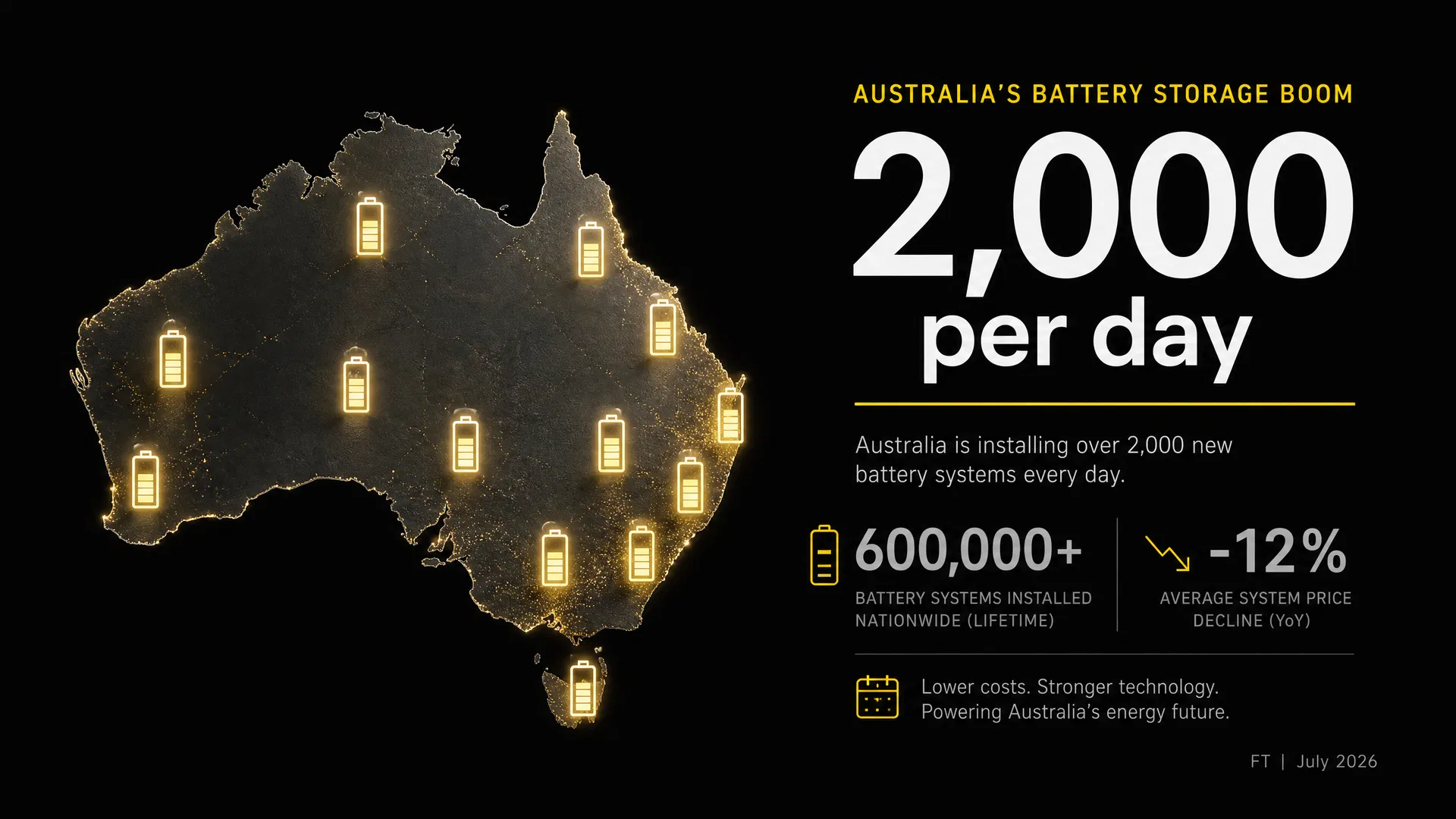
The Financial Times reports on July 13, 2026: The country is currently installing around 2,000 home batteries per day. Over 600,000 battery systems are already connected to the grid. Per million inhabitants, Australia has more than 2 GWh of storage capacity – a global record.
A Rystad Energy analyst says: "We have never seen anything of this magnitude before."
The Numbers That Matter
What fascinates me as an entrepreneur about this example is not the superlatives. It is the economic logic behind them:
Electricity prices are falling. Generation costs dropped 12 percent in Q1 2026. Not because of government subsidies, but because batteries are displacing expensive gas plants during evening peaks.
Even those without storage benefit. Less grid strain during peak times = lower wholesale prices for everyone.
The math works. 40 percent of Australian detached homes have PV. Adding a battery means using your own electricity in the evening instead of feeding it in at 7 cents and buying it back at 30 cents.
Why This Matters for German Mid-Market Companies
In conversations with management teams, I keep hearing: "Storage does not pay off yet." Or: "We are waiting for better conditions."
Australia shows: The conditions are already here. What is missing is speed.
The parallels are obvious:
- High PV penetration (growing strongly in German commercial sector too)
- Falling battery prices (minus 50% in 2 years for LFP cells)
- Aging fossil infrastructure (coal plants going offline)
- Grids under pressure (peak loads becoming problematic)
The difference: Australia acts. Fast. Pragmatic. Economically driven – not ideologically.
What a CFO Should Take Away
1. Storage is no longer a luxury – it is infrastructure.
Operating a PV system without storage today means giving away value creation. Commercial storage payback is now under 7 years – and falling.
2. Peak shaving reduces grid fees.
In Australia, households with batteries draw 80 percent less power from the grid than PV-only homes. Applied to German commercial sites: Less peak load = lower demand charges = direct OPEX reduction.
3. Vehicle-to-Grid is coming.
Australia is launching pilot programs for bidirectional charging. Every EV becomes a mobile battery. Anyone planning charging infrastructure today should factor in V2G capability from the start.
4. Speed decides.
2,000 batteries per day. 137 large-scale projects under construction. Australia shows: Those who act early secure the economic advantages. Those who wait pay more later – for grid fees, for carbon levies, for missed self-consumption quotas.
My Assessment
Australia confirms what I have been advocating for years: The real energy transition does not begin with solar panels alone. It begins with the combination of renewable generation and storage. Only batteries turn weather-dependent energy into an always-available power source.
"Solar ate coal's lunch and now batteries are eating gas's dinner" – as Tim Buckley of Climate Energy Finance puts it.
For German mid-market companies, this means: Do not wait. Calculate. Act.
Transformation starts with knowledge.
Receive regular analyses, insights and decision-making frameworks on energy, industry and strategic development.
No spam. Unsubscribe anytime. Your data is processed according to our privacy policy.
Connect with Frank Hummel on LinkedIn
For latest insights on energy, electrification and innovation